
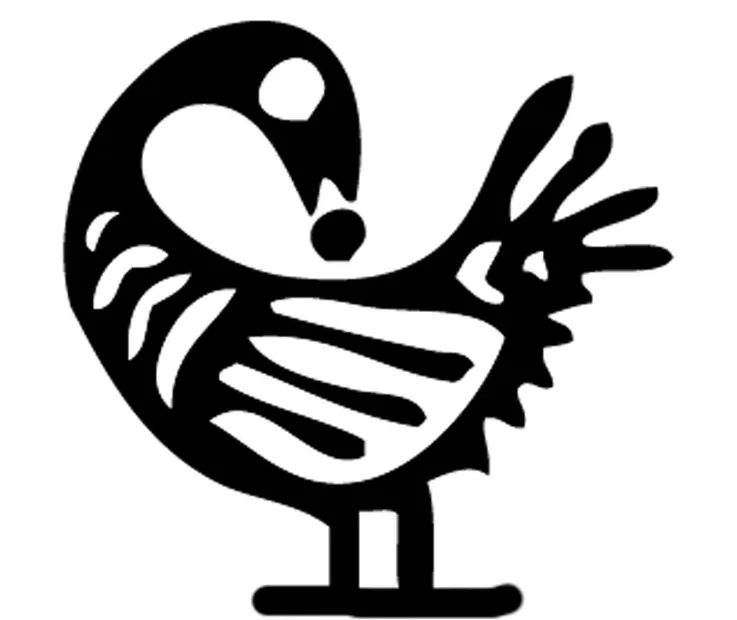
The past surrounds me. I’m sure there are a plethora of parables that beg caution about this, but I need to process the past at this stage of my life. Humanity, especially those living within the American Empire, doesn’t process the past enough. The current news cycle is 24 hours, not a week. Social media begs us to condense our lives and thoughts into 30-second snippets, eliminating nuance and progressive conversations. Hell, because of the economy, many people don’t have the time to process the past because survival is a time-based horrorscape. I fear we don’t process the past, even the recent one, enough to properly understand and grieve to create and reimagine better and sustainable futures. As I learn about the meanings and history of the adinkra symbols, I realize one that resonates with me at this stage of my life: Sankofa. We must look back in order to move forward and reimagine new and sustainable worlds.
For those who do not know, Sankofa is a word in the Twi language of the Asante people in Ghana. While it loosely translates to “go back and get it,” the complete proverb translates to “it is not taboo to go back and fetch what you forgot.” Throughout Black media and art, this concept is used in our efforts to help with questions of identity, perseverance, and belonging. But with the onset of anti-intellectualism, the intentional failures of the American education system, as well as propaganda and bias deeply embedded into every facet of our lives, connecting to our history and the critical/ necessary items is becoming exponentially difficult. We are still dealing with the white-washing of Black and Brown histories in America through policy at an alarming rate in nearly all facets of life. Many social media algorithms maintain or exacerbate societal biases by limiting the reach of Black and Brown voices, especially when their content is designed to advocate for marginalized communities. As stated earlier, many places on the internet force us to create entertaining hooks in under 30 seconds, eliminating nuance and deep thought from many conversations. The desire to create legacies and the status symbol of intelligence versus the actual process of learning and being intelligent is an epidemic in our communities (please watch F.D. Signifier’s video on Terrence Howard. I beg you!!) It is challenging for adults to combat this daily, so imagine what our children face.
Thankfully, there has been a desire to combat this on a community level since the 2024 presidential election. I’ve noticed more people in the online Black Book community add more nonfiction to their reading goals for 2025. Some have decreased the amount of literature they read and highlight from white authors on their accounts, all in an effort to connect with the tenacious spirit of our ancestors. This shift in mindset excites me because it is the first step to creating change on the individual level while we prepare for an uncertain and unstable future. Many of us were raised with an education system that did not encourage the imagination necessary to envision new systems. We can build a solid foundation to reconstruct our society by reading these books, fiction and nonfiction alike. (Please note, this can be done with all media because ALL of it is political and a form of storytelling). Changing the systems means understanding how it has impacted our communities.
So this year, I want more people, especially Black people, to read the texts of our ancestors and elders who fought to preserve our history and culture. Those who helped our community survive and thrive. I want us to read the texts that help us process the traumatic events of our histories and learn how to protect ourselves from these traumas in the future. I want us to understand the difference between slave narratives and neo-slave narratives and read them both to help us heal. I want us to experience radical joy and celebrate where we are currently: the art being made, the representation we are fighting for, and the movements that seek to return us to our connections to the earth. I want us to start with small, individual changes and work towards addressing the changes in the community, nation, and world. We have many obstacles ahead of us, but there is too much at stake to give up.
You need the past to reimagine the future. Much like jazz music, you can’t break the rules of the genre without a clear understanding of the rules in place. While staying in the past or believing it is the ONLY key to survival is a recipe for disaster, it is a pillar many people forget when they speculate about the future. We need the past and the present to imagine the future. We need both.
What are you doing this year to process your past and present to reimagine your future?
Until next time,
Keisha
Leave a Reply