
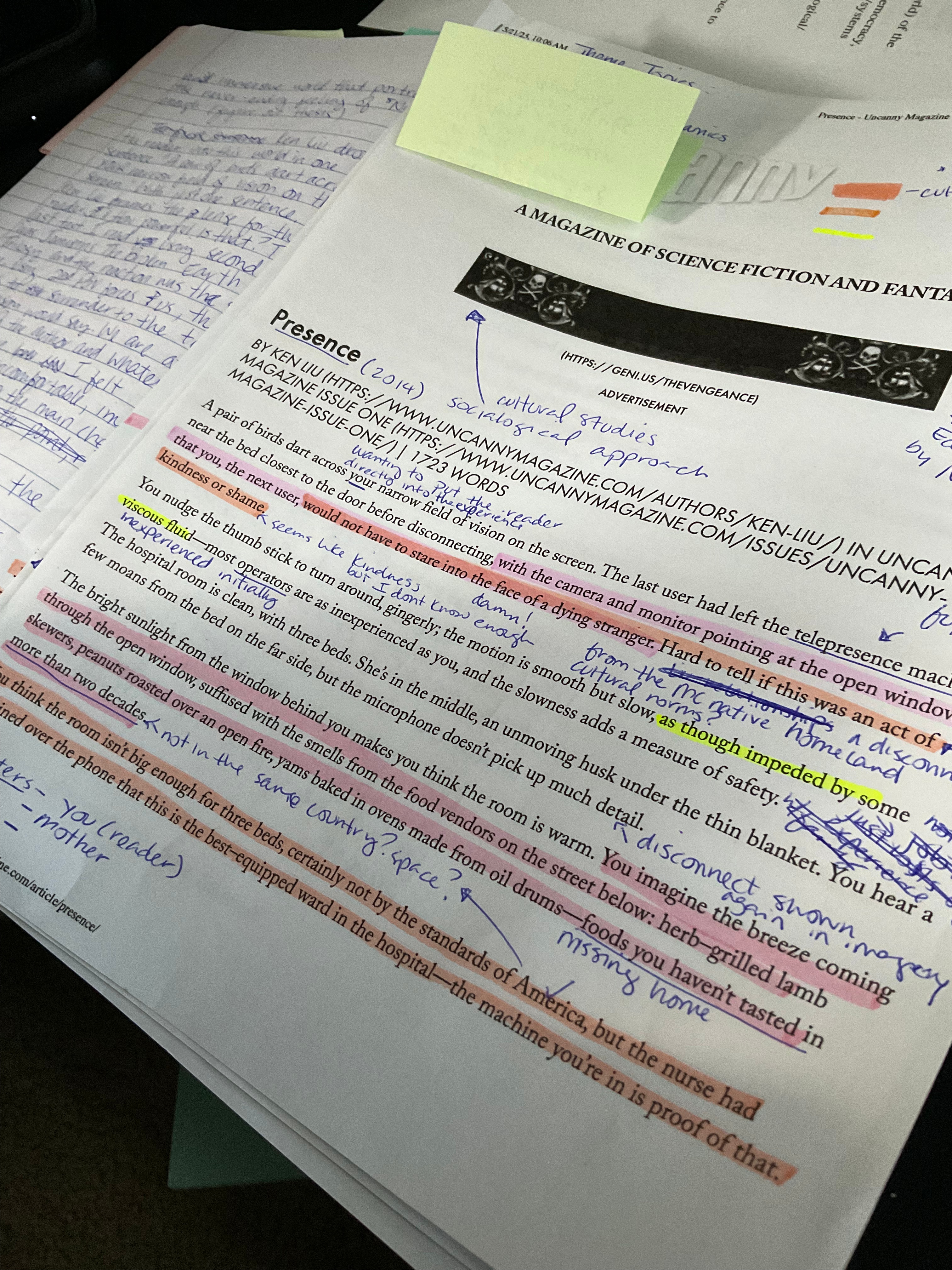
I chose this short story after a recent conversation about the author, Ken Liu. While sharing book recommendations and current reads, I said, “Dandelion Dynasty is the greatest series I never finished.” In fact, The Wall of Storms is easily one of the top five books I have ever read. I wanted to convince myself to dive back into his writings, and for me, that means starting small with a comic or short story.
This week’s Short Story Session features “Presence” by Ken Liu (2014), which can be found online in Uncanny Magazine. Presence follows the interactions between the main character, who has immigrated to America, and his bedridden mother, who still resides in their homeland. Through Liu’s use of the 2nd POV, Presence becomes a heartbreaking and immersive exercise in identity and empathy. The second POV forces the reader to ‘surrender to the text’ as Toni Morrison would say. Our surrender allows us, the reader, to create empathy for immigrant families split between the assimilation into American culture (which firmly places them on the fringes of a toxic society) and the longing and remembrance of their homeland.
Ken Liu plops the reader into his world with just the first sentence. “A pair of birds dart across your narrow field of vision.” Immediately, I felt uncomfortable and walked in shoes that were no longer mine. I found it to be a great, bold choice by the author. What better way to strip a reader of their biases and expectations? As stated earlier, in the second POV, the reader must surrender to understand the author’s message. Surrendering to the story is especially important when dealing with politicized topics like immigration, racism, gender, etc. Liu wants us to feel everything the main character is feeling, and he succeeds, leaving the reader to experience grief, longing, discomfort, and love on a more personal level.
The imagery in Presence exacerbates the feelings of discomfort and longing. Most of the imagery was imagined by the main character. The telepresence used to interact with his mom cannot recreate these senses. So, the reader/ main character imagines the smells wafting through the window. They are imagining the excrement being cleaned off of his mother. It’s an immersive and consistent reminder of the main character’s disconnect and longing for their homeland and culture. This adds to the main character’s self-awareness of not being physically present for their mother.
Experiencing the relationship between the sick mother and the main character was also beautiful in a way. The mother’s love (or at the very least respect) for her son is evident. She maintains eye contact throughout all of their interactions, something she never does, as confirmed by the nurse. Through all the negative emotions about their distance, the main character still tries to take care of his mother. He masters the telepresence machine and is given more freedom with it. He learns to take care of his mom in the same way she observed the nurse doing earlier in the story. He clearly loves her, and that love is his motivation to give her the best he can within his limitations.
The reader also experiences the guilt and burden of assimilation into American culture. This is mainly experienced through the interactions between the nurse, the mother’s roommate, and the main character. He (the main character) even has a brief meltdown, explaining how much he has to bear. The guilt he faces for not speaking his first language. His mother’s roommates asking him to visit more often. His struggle to balance his worlds is evident, and I wanted to help carry some of the burden. But once again, that is the point. To create empathy and humanize folks who are just trying to exist.
In under 2000 words, Liu forces the reader to understand the challenges of those who immigrate to America. I love stories that don’t allow space to misinterpret the author’s message, especially when dealing with politicized topics, and 2nd POV was an excellent tool for the job. Thinking back on past reads, The last text I read using the second POV was NK Jemisin’s The Broken Earth Trilogy (which, if you haven’t read it yet, why not? Please go to the library, buy the book, or something! PROMPTLY!) and both works have sold me on the use of second POV. It could be because it’s being used to create empathy rather than just a surface-level adventure. On a more personal level, the story reminds me of my best friend, who is currently in Japan and taking care of their father in his final days. It’s a moment they have been preparing for for years, but I still await with bated breath the grief of the second death. I genuinely hope you get a chance to read this story!!
If you enjoyed this, please share the article, subscribe, and comment below with your favorite parts of the story! Next week’s story is “Southern Hospitality,” a comic short from the comic anthology Noir is the New Black: Noir Stories from Black Creators written by Mikhail Hardy, with art by Eli Johnson and colors by Robin L. Davis. Happy Reading!!!!
Short Story Sessions is a new series where I, Keisha, attempt to dive back into the fray of literary analysis with speculative fiction short stories and comic shorts written by Black, Indigenous, and other Writers of Color. Every week, I’ll post a pic of my annotations as proof that I’m staying on it.
Leave a Reply