
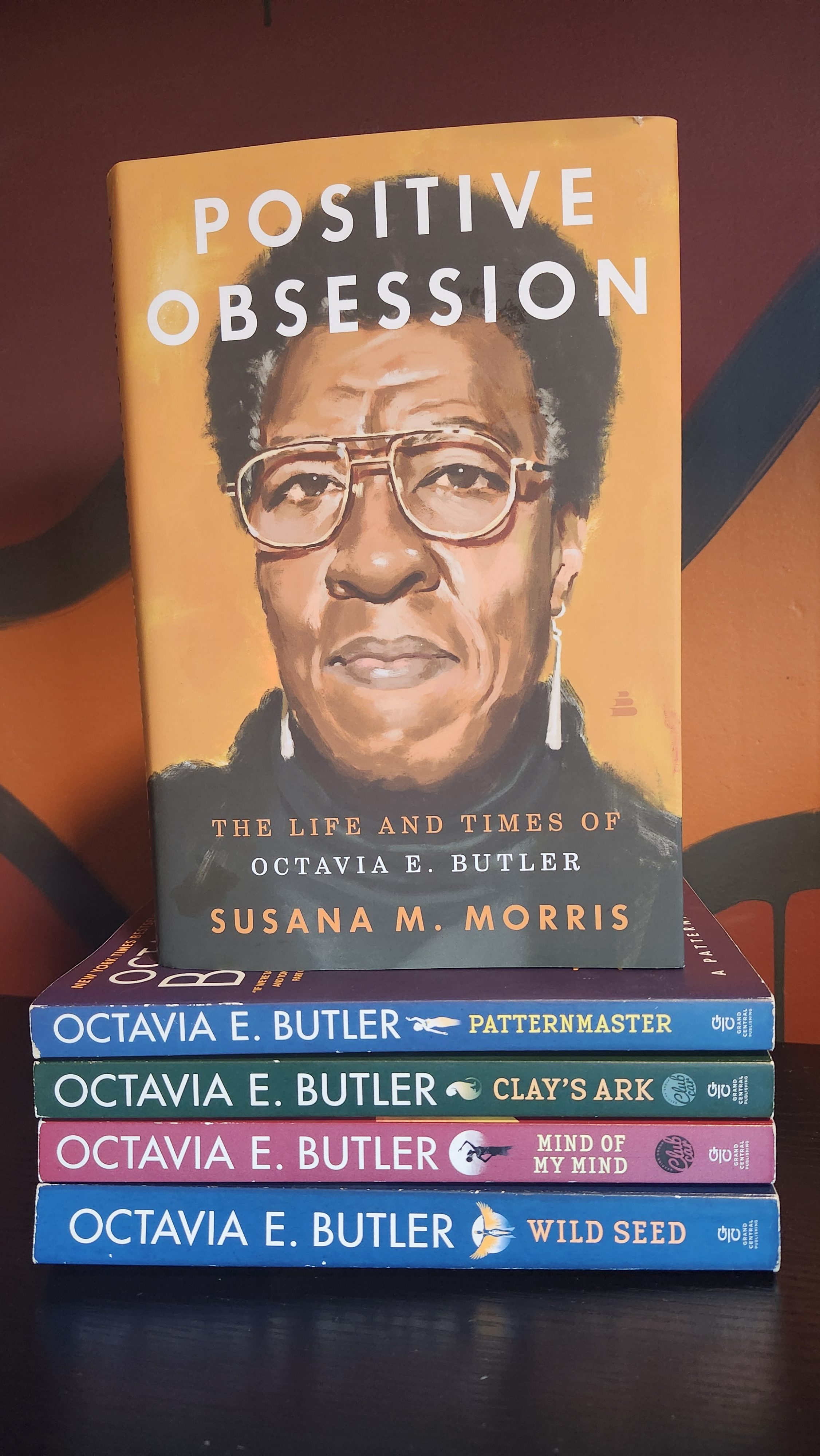
I was shocked when I heard that Octavia E. Butler’s Survivor was returning to print. For a few seconds, I couldn’t figure out what to do with my body, my hands, this news. I went to check the official Octavia Butler Website, Hachette’s website, and their social media accounts, hoping this wasn’t true. But there it was. A collaboration post between Butler’s estate and Headline Books that made my blood run cold and turned my lips curl in disgust and disappointment. Some may argue this is an overreaction, but I’d argue that it is justified, as Butler stated on record, multiple times, that she didn’t want this book to ever return to print.
Survivor, published in 1978, is the fourth book in the Patternist series by Octavia Butler. The series is a loosely connected story that addresses posthumanism and colonization, much like many of Butler’s other literary works. Where Wild Seed and Mind of My Mind center on Earth and its native immortal beings that serve as the catalysts to new, psionic human evolution, the rest of the series incorporates aliens and goes on some interesting, but admittedly left-field, tangents.


No Matter What, She didn’t Want Us to Read it
As stated earlier, Butler has gone on record multiple times detailing the perceived failings of Survivor. In Positive Obsessions: The Life and Times of Octavia E. Butler by Susana M. Morris, Octavia Butler says, “Survivor was the book that I used to get myself to Maryland to [to research Kindred], which is why it isn’t a very good book. And I tell people not to buy it, which for some reason makes them go out and buy it.” (Morris, 48) Butler also considers the book her Star Trek novel, a negative association, as she says:
“When I was young, a lot of people wrote about going to another world and finding either little green men or little brown men, and they were always less in some way. They were a little sly, or a little like “the natives” in a very bad, old movie. And I thought, “No way. Apart from all these human beings populating the galaxy, this is really offensive garbage.” People ask me why I don’t like Survivor, my third novel. And it’s because it feels a little bit like that. Some humans go up to another world, and immediately begin mating with the aliens and having children with them. I think of it as my Star Trek novel.” (Tor.com)
When Butler was in a financial and artistic position of influence, she urged publishers not to reprint the novel. Survivor’s last US reprint was in the late 1980s, with a few translations going into the early 1990s.

Stretching Self-Definitions for Our Benefit
Now, I admit I’ve always been more than curious about Survivor. Butler is one of my favorite writers, and I firmly believe that her perceived worst is still far better than most authors’ opus magnum. But when I learned that she didn’t want readers to read Survivor, I unfortunately agreed with Butler. Or, at least, I made stipulations, promising that I wouldn’t read the book unless I had one of the original editions in my personal collection. It’s been years of scouring second-hand book shops, of me holding out hope I can find a copy of Survivor. I’ve seen mutuals get lucky at yard sales and seeing them rave about buying their copy for $3- I’m so happy for them, but also, seething with envy. Buying it online is a nonstarter, with some copies starting at $2000, something I’m too broke to even consider. But this was my promise to Butler and her art. Because I want to respect the boundary she created.
This reprint seems like an egregious overstep of Butler’s boundaries and personal agency. This is not me getting on a soap box to diminish others for their choices to buy the reprint. I am at fault for this as well with other authors like Toni Morrison. I find myself stretching Morrison’s self-definition as an artist in an effort to help others understand speculative fiction and its influence over Black literature and liberation. But where is the line drawn? What stretch was made to justify this breach of Butler’s agency?
Using my logic for Morrison, it doesn’t look like this reprint would expand on anything that Butler hasn’t already done. Based on reviews and analysis I’ve read of Survivor, it’s not needed to understand the Patternist series anymore than we already understand it. The series technically reads like a bunch of standalones with a vague thread of connection. The first two books are more connected to one another than the 3rd and fifth book. There would be an argument if Survivor was book three in the series because then it could operate as the lynchpin between the two larger stories in the series. Alas, Clay’s Ark fulfils that role…just barely.
And let’s remind ourselves that Butler had many issues with Survivor, especially the way sex is used and how it didn’t make sense that there were already humanoid aliens on the new planet to procreate with. She sought to rectify that with the Xenogenesis series. Every issue of colonization, sex, alien invasion, missionary work, etc. that Butler addresses in Survivor is addressed to Butler’s satisfaction in Dawn, Adulthood Rites, and Imago. Butler is such an intentional writer; why not trust her with her own stories? Sure, it could be good in the eyes of the reader, but Butler always has meaning and messaging that make it impossible to take anything from her work other than what she intended. Writers, historically and unfortunately, have had to tread carefully where sex is concerned. It has had far too many implications and stereotypes when in connection to Black and Brown folks. This is not because we aren’t sexual beings and not deserving of that complexity. But rather because of how society still weaponizes sex against us. Maybe she thought the way sex was used in Survivor allowed for too many interpretations for her comfort. She did, and does, have a mixed audience. We, as readers, need to respect that discernment.
AI’s Influence over Survivor’s Reprint
It also frustrates me that large language models have an influence over this reprint being given credibility. The LA Times reports that Alyssa Collins, the inaugural Octavia E Butler fellow at the Huntington Library, Art Museum and Botanical Gardens, signed off to write the introduction to this reprint because she learned the book was already being used to teach and influence AI. Is that the real reason why Butler’s wishes were disregarded? Not because of access to the general public, but because the publisher/ estate was unable to profit from a book that was used in LLMs? I truly hope this isn’t the case, but I have very little faith in late-stage capitalism.
Regardless of what I, or anyone else, thinks of her work, she had her reasons why the book shouldn’t be reprinted. Octavia E. Butler is one of the few authors whom I buy multiple copies and multiple editions of her work. This is one book I will not add, not this new edition. Because, and I can’t stress this enough, she didn’t want us to read it.
Works Cited
“All Books.” Octavia E. Butler, http://www.octaviabutler.com/work.
Mendez, Malia. “Octavia Butler’s Disfavored Novel “Survivor” Will Be Republished.” Los Angeles Times, 23 Apr. 2026, http://www.latimes.com/entertainment-arts/books/story/2026-04-23/octavia-butler-survivor-new-edition-reprint. Accessed 26 Apr. 2026.
Morris, Susana M. Positive Obsession. Amistad Press, 5 Aug. 2025.
Walton, Jo. ““My Star Trek Novel”: Octavia Butler’s Survivor – Reactor.” Reactor, 5 Feb. 2009, reactormag.com/qmy-star-trek-novelq-octavia-butlers-survivor/. Accessed 28 Apr. 2026.


Leave a Reply