
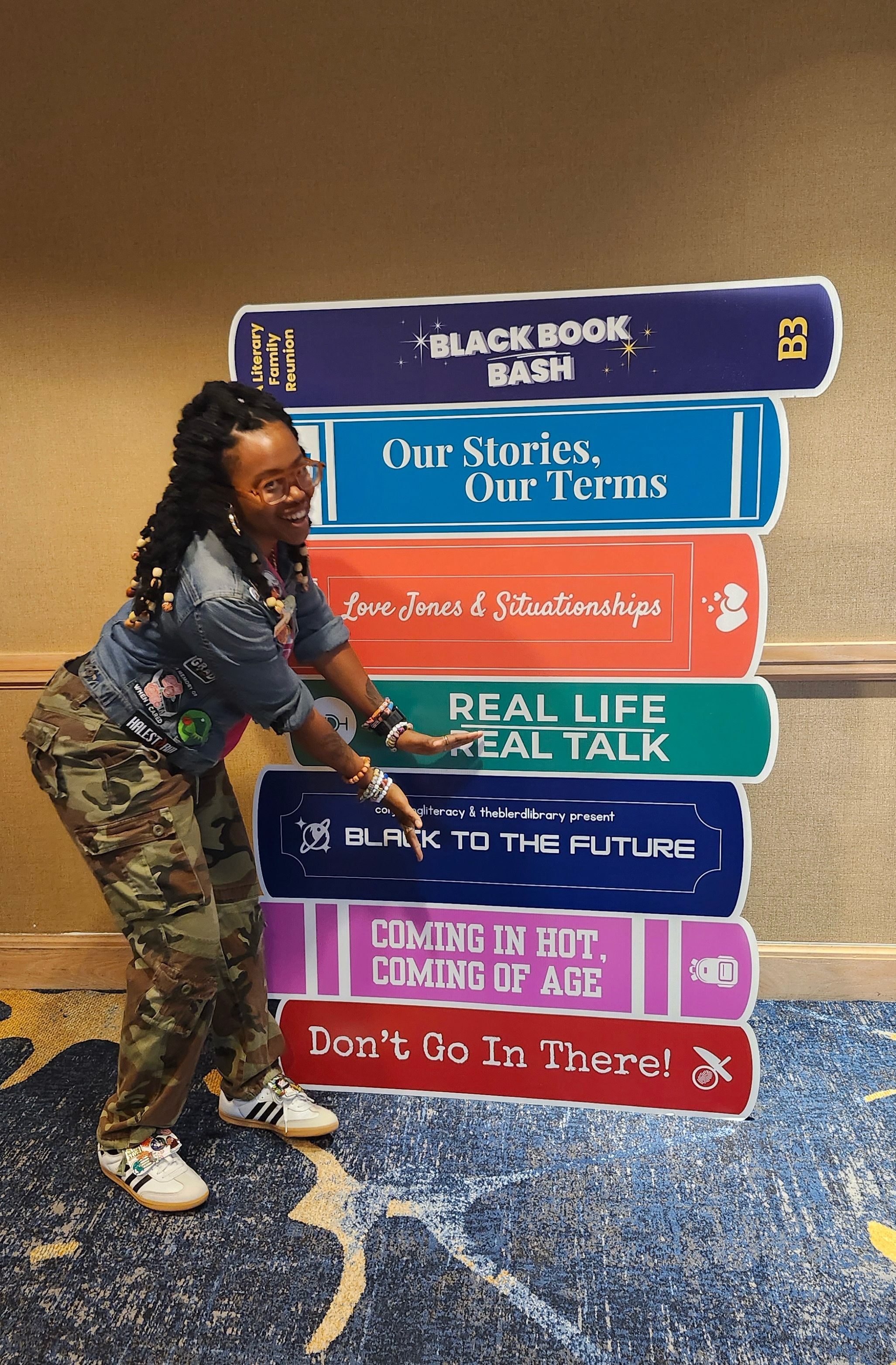
At the end of the Black Book Bash, a group of creators sat and ate one last meal together. Each of them ordered some variation of meals they enjoyed throughout the weekend, hoping to maintain the good vibes now imbued in their lemon pepper wings, mimosas, cheesecakes, and burgers. They talked about the event and the successes they got: one author was able to clear up preconceived notions surrounding his book, another author was given career-changing introductions and advice, and the social media creators at the table made a pact to be more intentional and consistent. But one creator, yours truly, gained so much more.
My Fellow Nerds,
I had the amazing opportunity to co-curate the Black Speculative Fiction panel programming with Conjuring Literacy at the Black Book Bash in Jacksonville, Florida. It was an enlightening experience from beginning to end. First, being able to take all of my panel proposal ideas and put them into one Festival was fun and stressful. We ensured everything flowed together and chose the right panels to balance joy, education, and general interests. I’d like to say we did that successfully. We had some amazing panels about romantasy, YA speculative fiction, men’s indie books, and women using Black speculative fiction to heal. I really think we did a great job with space to make next year even more impactful. Even today, a week after the event, I’m already brainstorming ideas for next year and considering the authors’ suggestions.
But we’re here to talk about yours truly and the growth I experienced at the black book Bash. There are several areas of my personal life, as well as my life online, that flourished this weekend. I am not a social person, or rather, I have a deep-seated fear of rejection that blossomed into a decades-long toxic relationship with anxiety. Since I just don’t understand much about humanity, it takes me a while to meet and talk to folks, but this past weekend helped heal a lot of that for me. While I didn’t walk up to everyone I know and see online, I was able to have some great conversations with folks. Those dinners with Alissa, Helena, Lo, Lakita, Ladarrion, Shyheim, Ravynn, Bre, and my sister Bri did so much for me. Outside of the first night, we ate at the same place, had almost the same food, and talked about the most random things. There was vulnerability, accountability, community, and hilarity that I’m still thinking of fondly. Now, I won’t lie, when I went back home, I started to panic. What if it was a dream? What if this was a beautiful experience that happened in isolation and won’t transfer into real life or online? I’m happy to say that is not the case. I’m seeing more people talk online, and I’m talking to more people! I needed that in-person space, and I’m forever grateful for it.
The most significant event for me was realizing what I wanted to focus on in grad school. That revelation has me exploring grad programs in a serious way now. It began with a conversation about Black conservatism. There was a question proposed that threw everyone off kilter at a panel. Because the creator is young and many folks, including the creators of the Black Book Bash, intervened, I won’t dive into details about it. But the shock of such a proposed question spilled into one of our dinners. I did some research and found what I typically find when that specific question is proposed: Black Christian conservatism. My mind was percolating with thoughts past and present. Past papers exploring the absence of agency and happiness in Judeo-Christian gender roles. Current explorations of god-punk, and a general love for stories where mortals interact with divine beings and monsters. I was on a roll.
And so with these thoughts and conversations, we shared our last meal. We talked about what we’re going to do next. After being affirmed in my desire to go to grad school, justin a. reynolds asks me, “So what do you want to focus on?” A slow smile crept on my face because it’s the first time I finally have the language and confidence to say it out loud. Everyone knows that I want to focus on Black speculative fiction in grad school and use comics in a large capacity. But in terms of a specific topic, I turned to him and said, “Let me preface this by saying that I did not grow up in a religious household, but because I grew up as a black woman with strong Southern ties and in a Black Capitalist household, I grew up with Christian gender roles and expectations. While being on the outside of that culture but still impacted by it, I became fascinated with religion. With how humanity attempts to make sense of its existence. Through religions, mythologies, and traditional cultural practices, we try really hard to make sense of the beauty and harm we’ve experienced, especially within the Black American community. And so I’m fascinated with how religion operates for the individual and community, but also how it’s weaponized and used to create harm. And with Black speculative fiction specifically, I like seeing how writers critique and explore the historical implications of religion through interactions with gods, Celestial beings, and monsters, and what that would mean for Humanity? What would these interactions mean for our past, present, and future as it relates to the progress and harm we are perpetuating on the individual, community, and the planet at large?” The table went silent with nods of affirmation.


With this newfound confidence, I now sit here on a Thursday morning at 5:30am, writing and preparing for another day of graduate program research. After this weekend and a conversation with THE John Jennings, Dr. Christian Hines, Dr. Michael Dando, and Dr. Stanford Carpenter at SDCC, I decided an interdisciplinary program would be best. I’ve discussed with friends what type of program suits me. Initially, I thought I’d enter an English Department for my master’s and PhD, but I’m realizing that may not be ideal since most of my work is online and involves various media. A digital humanities or cultural studies program may suit me better. If you have suggestions, please let a sistah know!
Another project that was birthed at the Black Book bash, along with my concern about the ongoing anti-intellectualism movement, is weekly lives on Mondays! I want to be able to offer a space where we can close read and slow read texts because some books should not be read in silos. We need to be reading these books in community to have conversations that move us towards a decolonized mind and stronger community ties. And so, starting next week, every Monday, I will go live to slowly and closely read stories and discuss what they mean for liberation, joy, reclamation, and radical thought.
During the live this past Monday, we brainstormed which stories we would be working with first. Because it’s October, it’s Black Speculative Fiction Month, and Halloween is around the corner, we decided to start with a horror novella, specifically, The Ballad of Black Tom by Victor LaValle. I love this novella, and it’s one of the stories that helped me discover my love of Black horror. The Ballad of Black Tom is a response to HP lovecraft’s short story titled “The Horror at Red Hook.” Now, for those who don’t know, Lovecraft is widely considered racist, and it is strongly conveyed in “The Horror at Red Hook.” The short story is based on a neighborhood in Brooklyn known for its diversity. And so LaValle wrote The Ballad of Black Tom as a reclaimation of the Black experience and chose to center it around a black man who’s processing the death of his father at the hands of the police. In order to have nuanced discussions, we’re going to read the short story first and then move on to the novella.
If you’re interested, this will be on Instagram, Mondays at 11am EST. If we keep the habit, I’ll likely move it to YouTube or possibly Discord. I’ll post the link to the short story here, which is free online. This gives people time to get The Ballad of Black Tom for personal or public libraries—let’s support our libraries!
This past weekend gave me new confidence, deeper community bonds, and renewed excitement about my future. I am eager to help my community, continue meaningful discussions, and pursue my academic goals. I look forward to planning next year’s B3 event and hope to see you there!
Until next time,
Keisha Parks
Leave a Reply