
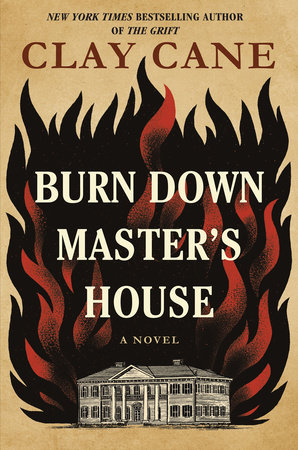
This isn’t a review of Burn Down Master’s House by Clay Cane, the historical fiction novel, published by Penguin Random House in January 2026. I have loved neoslave narratives since being introduced to them at my alma mater, Lincoln University so it’s been a highly anticipated read of mine for this year. And with 2026 being the year of barely there funds, I impatiently waited for one of my library holds to bless me with book. A few weeks ago, the Libby gods blessed me…. kind of.
Burn Down Master’s House is good. But I question the novel’s position as a neoslave narrative when the novel centers the white gaze, something the genre rejects in both form and function. If you loved the story, that is great. Continue to love it because, as I said, Burn Down Master’s House is a solid story of resistance, love, and community that follows some of the tenets of the neoslave narrative genre. This book also invokes rage, angst, and heartbreak in telling such stories. It tries its absolute hardest to release you from those negative feelings, but falls short of freeing its reader because the white gaze is always there, per the author’s intentions.
Intended Audiences Matter
Now I know what I’m about to discuss will ultimately be in mixed company. I know the demographics of my literary community online, and there are quite a few white folks I know that read and watch my content. My issue is in the intention of the audience rather than who happens to show up.
When I think about my audience, I think of Sami Schalk’s mindset. Paraphrasing their introduction in Bodyminds Reimagined, this, both my corner of the digital and real world, is a very Black home, and while I don’t mind folks visiting, you, dear white people, must always understand that you are a guest and constantly mind your manners. You must never get too comfortable. Keep your feet off my coffee table and remember that certain conversations will not be entertained. You are relegated to the living room and that half bathroom in the hallway, the one you just walked past on your way in here. This home and these writings stem from a deep and overwhelming love of the Black community; the people I love and would want to come back as in every lifetime.
That love and sense of self is what I appreciate about the differences between slave narratives and neoslave narratives and the differences between British literature and many of their Black and Brown retellings and adaptations. Both, in their own ways, have an the intentional shift away from the white gaze and a desire to represent the Black identity. It’s finding ourselves in a world that has tried to erase us through systems and policies.
In the introduction to Burn Down Master’s House, Clay Cane states, “Perhaps, just perhaps, the real fear isn’t Black and Brown people knowing their history- it’s young White children being inspired. The possibility that they might see themselves not in the oppressors but in the rebels, the freedom fighters, the ones who dared to demand a better, more just world. That’s why this novel is for everyone, a story not confined to race or ancestry but rooted in a universal struggle.” (Cane, 9) This declaration threw me for a loop because here is a story that operates like a neo slave narrative in its reclamation of Black history and liberation, and is defined as a neoslave narrative by its author. Still, its intended audience includes the white gaze and their representation.

Slave Narrative vs. Neoslave Narratives
Let’s backtrack a bit and explain the differences, in both form and function, between a slave narrative and a neo slave narrative. A slave narrative is an account of an enslaved person that is either told by them or is transcribed by someone, usually a white person. The purpose of these stories was to help white folks understand the horrors of slavery to white people and gain their sympathy in the emancipation of enslaved folks ie, create more abolitionists. So even in advocating for their freedom and bodily autonomy, enslaved people needed to find the right balance of sympathy and strength to appeal to white people rather than outright state their barbaric lived experiences of enslavement. In Toni Morrison’s craft essay “Site of Memory” that explains how she wrote Beloved and Song of Solomon, Morrison cites Lydia Maria Child, a “well know anti-slavery figure”, and her admission that the most brutal aspects of slavery are “generally kept veiled” in slave narratives. (Morrison, 237) Slave narratives, while some of the only primary documents of the lived experiences of folks in slavery are still not able to tell the full story because whiteness was considered in its creation.
Neo slave narratives seek to rectify this. Going back Morrison’s essay, regarding Beloved, Morrison saught to ‘find and expose the truth about the interior life of people who didn’t write it [their story] and part the veil that was so frequently drawn.’ (Morrison, 239) The genre allows us, the Black reader, to witness history being remembered through our lens. Informed by the archives, recollections, and imagination, the neoslave narrative disregards the white gaze, seeking to educate and heal the black community. It dives into the lives and internal worlds of Black people during times where we were silenced and erased both on and off the page. (Schalk, 36) Usually, in neoslave narratives, Black souls are freed or there is a liberation that may not have happend in real life. Novels such as Yellow Wife by Sadequa Johnson, Beloved by Toni Morrison, Jubilee by Margaret Walker, The Water Dancer by Ta-Nehisi Coates, and the short story “The Passing of Grandison” by Charles W. Chestnutt, operate in this fashion.
Cane himself defines the Burn Down the Master’s House as a neoslave narrative. In a recent Threads post, he asks to have Burn Down Master’s House included in the list of neoslave narratives. And so when Clay Cane says the book is for everyone in his introduction, I was taken back. How does a neoslave narrative hold both communities, opressor and oppressed, white and Black, simultaneously and equal in the intent of its story? Why is there no relegation to one area of the literary home? And what conversation would be okay for both peoples concerning such a sensitive topic of reclamation and healing?

In the interconnected stories of Burn Down Master’s House, Cane tells the story of several souls who fight for their freedom in various ways. The first chapter ends with the literal burning of a plantation. Another chapter focuses on a Black woman poisoning a family and escaping with other souls. Cane is brutal and resolved in his retelling. I loved that part. There were moments where I, someone well versed in and someone who prefers these types of stories, had to physically brace myself for the violence and emotional turmoil of the characters. And while I was experiencing and remembering histories forgotten, I was simultaneously questioning how Cane’s white readers were reacting to these same moments. Those were the times I absolutely hated my reading experience. It’s more than frustrating to experience these traumas being graphically told, and then worry about how his white audience would read and interpret the work. This contradiction undercuts the purpose of a neoslave narrative because those works are for us and by us. If other folks read it, that’s not an issue but the intentional thinking of them dims my experience of the story.
Mixed Company and Sensitive Conversations
There were a handful of places in this novel where I felt whiteness (the construct) sitting next to me, reading over my shoulder in a crowded bus, heavily breathing and, in that crowed and loud space, somehow still being the loudest person there. I dealt with it because at least the story isn’t sugarcoating Black history for the white gaze. But what really did it for me was the last chapter of the story. Chapter four, titled “Nathaniel”, focused on its titular character, a Black slave owner, who made his money selling runaway slaves back to their slave owners. Nathaniel used his experience as a former slave and being in community with other Black people to effectively and severely subjugated his own people. This is a very necessary conversation. Half of me was excited to see this person pulled from the archives and given due process. The other half dreaded the ways it could be misinterpreted by others and shaped into a weapon against the Black community. We know little about these types of historical figures and I believe we should discuss all of our story because this mentality has sustained itself throughout history, with many Black and nonwhite folks sacrificing the collective for their personal benefit.
Now, I am not found of calling out Black people in public spaces. Yes, people need to be held accountable to their actions but we have seen, especially in digital spaces, how those intracommunal conversations have been used and misused to push nafarious and anti- Black messaging. And so that commentary, while necessary, was incredibly discomforting in Burned Down Master’s House, knowing there are others who were welcomed at the table of our reclamation, education, and healing and could use it as anything other than what we, as a community, want decide it to be. Some conversations should not happen in mixed company. Again, these are thoughts that I don’t and shouldn’t have when addressing neoslave narratives.
Surprisingly, I still think the story should be read. Even in its hand holding (the novel doesn’t quite trust its audience to come to certain conclusions but I boil this down to his reasoning for the story existing in the first place, which is also found in the introduction), it still pulls stories and people from the archive. It creates a very necessary conversation. It enraptured me in some ways and had me fighting for every Black person in every story. But it considered too many people and didn’t give me the space as a Black person, a Black woman, to find freedom through the trauma. Whiteness was still in the room, and I hated every moment I was forced to remember them.
Is this why folks skip the introduction to some books? I wish I would have skipped the introduction. Maybe someone can do that and let me know if they come to the same conclusion.
SN: And for anyone reading and feeling uncomfortable with my feelings surrounding whiteness. That is one of the conversations I do not entertain.
Another SN: If you plan on reading it, please get an ebook or physical book. I have an ebook but I listened to the audiobook and I don’t recommend it at all. I found the audiobook hard to listen to because of the author’s cadence. He breaks sentences in unusual places that doesn’t seem to enhance the story.
Let’s talk about it in the comments!
Books Referenced:
The Source of Self- Regard by Toni Morrison
Bodyminds Reimagined: (Dis)Ability, race, and Gender in Black Women’s Speculative Fiction’s by Sami Schalk
Burn Down Master’s House by Clay Cane
Article I read but didn’t use but it’s still interesting:
“The Power of the Neoslave Narrative Genre” by Joan Anim-Addo and Maria Helena Lima https://www.jstor.org/stable/26776391?seq=1:
Leave a Reply